
What’s Driving Australia’s Cruel Mass Brumby Slaughter?
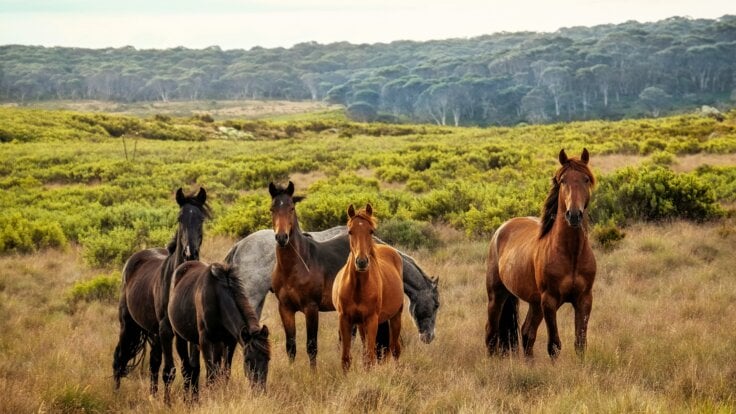
Romanticised in Australian literature, the brumby is part of our history. Sadly, though, these days, wild horses aren’t seen as legends of the bush, but as ‘pests’ to be eradicated.
As a result, Australia’s brumbies are the victims of cruel, short-sighted killings, usually via aerial shooting, where terrified horses are chased and shot by humans in helicopters.
Where Did Brumbies Come From?
Ever since their arrival with the First Fleet, horses have been used for transport, farming, and battle in Australia.
Although horses died for humans in wars, our loyalty to them lasted only as long as their usefulness, and many owners abandoned their steeds in the bush when cars and tractors became common.
Over generations, these wild horses adapted to survive in the harsh outback and alpine regions of Australia.
Now, inflated population reports are seeing these loyal, clever animals blown apart in ineffective massacres.
‘Culls’: Cruel And Ineffective
Aerial shooting is inaccurate. Many horses shot don’t die immediately, instead suffering painful and protracted deaths. After aerial kills, horses have been found barely alive, suffering from multiple gunshot wounds.
Many fatally wounded mares leave dependent foals who then starve to death. The RSPCA has also raised concerns about excessive chase times leading to pursuit stress in horses.
Dubious Population Reports Drive Deaths
There’s also debate about how brumby numbers are calculated. Officials base brumby numbers on estimates partly calculated on the assumption of unseen horses.
The final numbers reported are unlikely – impossible, even. Wild horses reproduce at a rate of 7 to 15%, but current top-end estimates on which this round of aerial shooting is based reflect an increase of over 315%.
Even if horses could reproduce this rapidly, that’s a red flag that the commonly observed ‘vacuum effect’ – where more animals move into an area to replace decimated populations – is at play, a sure sign that killing animals is myopic and ineffective.
Better Brumby Solutions Needed
During multiple public inquiries into brumby management in Australia, lots of expert advice has been shared, but largely unheeded.
Horse advocates argue that non-lethal control measures, like immunocontraceptives (fertility control), haven’t been given a chance in Australia, despite evidence from elsewhere in the world indicating this may be effective.
If experts are right and brumby numbers increase by hundreds, not thousands, each year, humane control options would be more than sufficient.
How You Can Help Brumbies
You have the power to help brumbies! Demand humane brumby population control by writing to: