Dirty Dairy: Investigator Finds Environmental Disaster on Australian Farm
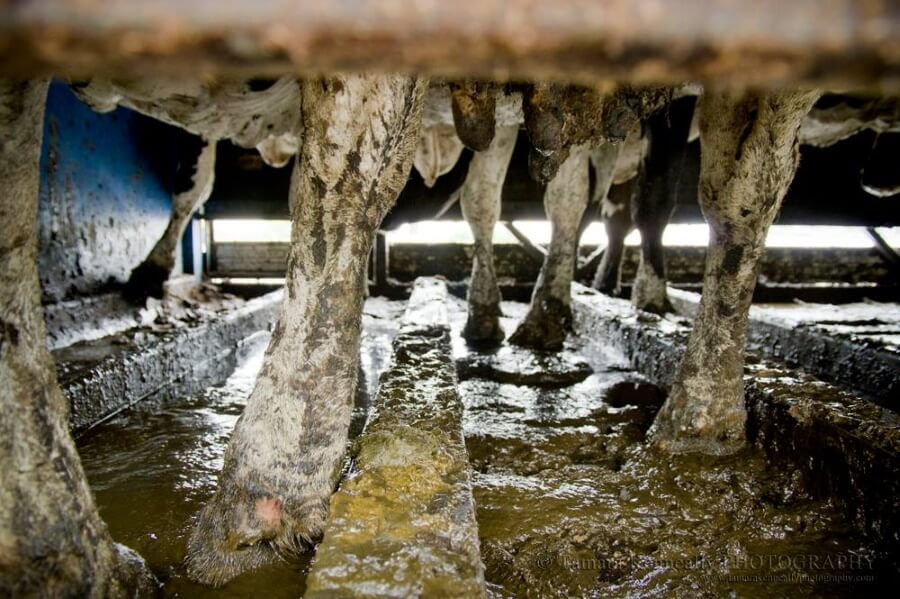
The recent release of PETA’s Australian dairy farm exposé uncovered barbaric abuse to calves and adult cows, but the horror doesn’t stop there: the investigation also revealed that effluent – faeces and urine – from the farm in New South Wales was repeatedly contaminating a nearby river.
After noticing that the effluent was overflowing, the eyewitness questioned farm workers regarding where it goes.
“[I]t goes down in the river,” the eyewitness was told. “We should have a backup storage. But we don’t.” “Everyone knows that it’s doing that. It’s just nothing they can do.”
Water Pollution
At the time of the investigation, the farm supplied Norco, Australia’s second-largest dairy cooperative, whose products are sold in supermarkets such as Coles, Woolworths, and ALDI, sometimes as store-brand milk and ice cream.
In 2011, the local government concluded that approving the plans of a Norco dairy farm in New South Wales to intensify production should be contingent upon the farm’s upgrading of its treatment and storage of effluent.
At that time, samples of effluent run-off from the nearby river tested 16 times higher for contaminants than the level that’s safe for human contact. Test results also revealed freshwater acidification, which can be harmful to fish and other aquatic animals.
After the eyewitness visited the farm and confirmed the continuing effluent run-off problem, the local government was notified.
Is Dairy Production Always So Dirty?
A cow used in the dairy industry typically produces around 60 litres of manure each day – so imagine the waste that’s being created by hundreds of cows on just one farm. Their excrement is extremely high in nitrogen, which leaches from the soil and enters waterways, contaminating the ecosystem and its inhabitants.
By forcibly impregnating and breeding more cows than would naturally be in our environment – for a “product” that’s unnecessary for everyone but baby cows – we’ve created an environmental disaster.
To see the results, look at New Zealand, where it’s been revealed that 60 per cent of monitored waterways aren’t fit to swim in – let alone drink from – thanks largely to dairy production. A report by the National Institute of Water and Atmospheric Research found that “[s]treams in dairy land are among the most polluted.”
Water pollution aside, the dairy industry alone produces around 12 per cent of Australia’s greenhouse gas emissions. In total, all the animals used for food or clothing in the country produce 50 per cent of the emissions.
What You Can Do
The next time you’re shopping for food, you can either help or hurt the environment. Help stop the disaster caused by the dairy industry by taking our 30-day vegan pledge and by trying some of the many varieties of delicious dairy-free milks, cheeses, yoghurts, ice creams, and other products that are readily available in stores across Australia.
Help Animals in 2026: Renew Your PETA Membership!
Donate Now